Before anything else about the Similans (the granite, the swim-throughs, the mantas), there is one fact that determines whether your trip can happen at all, and a startling number of guides don't mention it.
Mu Ko Similan National Park closes every year from 15 May to 15 October. Not "gets quiet." Not "is harder to reach." It is closed by order of Thailand's Department of National Parks, to all visitors and all boats, for roughly five months. There is no diving in the park during the monsoon, and no operator can take you.
The park reopens 15 October and runs through 15 May. If you're reading this in the northern summer, you are reading it in the off-season, and the earliest you can dive the Similans is mid-October.
With that established, here's how to plan the trip properly.
When to Go
| Window | What you get |
|---|---|
| 15 May – 15 October | CLOSED. No access, no exceptions |
| Mid-October – November | Freshly reopened, quieter boats, conditions still settling |
| December – February | Peak season. The best sea state, the busiest boats, and the highest prices. Book well ahead |
| February – April | The sweet spot for wildlife: best visibility, and the manta and whale shark window |
| Early–mid May | Last call. Boats wind down before the 15 May closure |
Be careful with pricing folklore here: peak season is more expensive, not less. Anyone telling you the quiet months are pricier "due to scarcity" is describing months in which the park is shut.
Water temperature is a non-issue, a steady 27–30°C year-round, so a 3 mm suit or even a rashguard does the job. Visibility runs roughly 20–30 metres, best from February to April. The variables that matter are sea state and plankton, not temperature.
The Sites
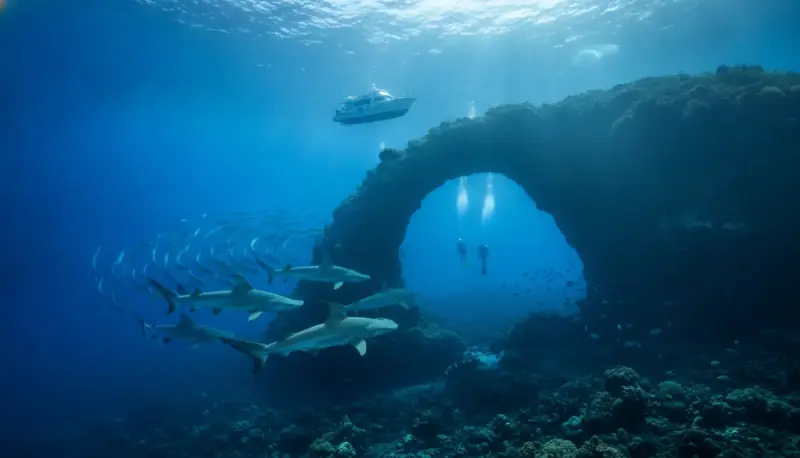
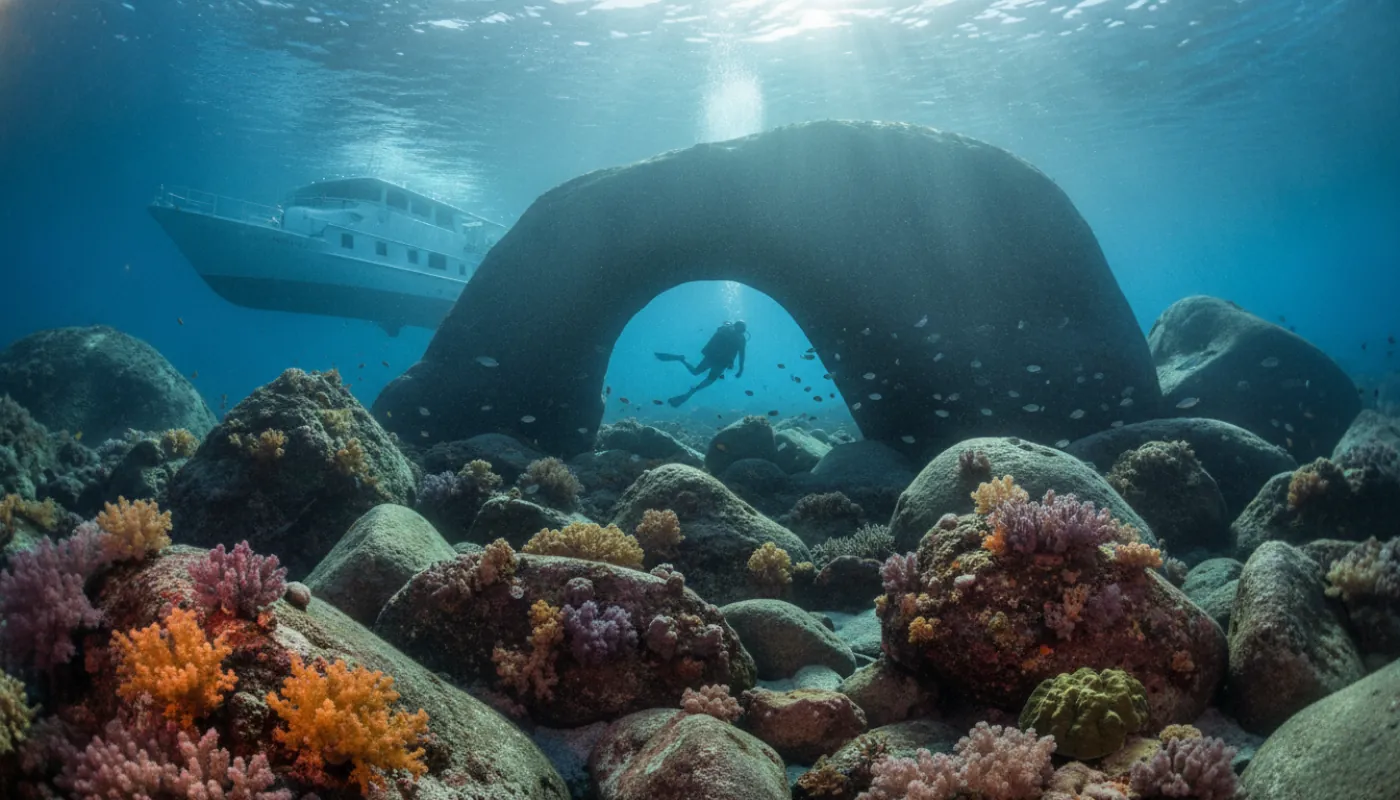
The park is eleven granite islands (the original nine Similans plus Koh Bon and Koh Tachai, added in 1998), and the diving is defined by that granite: boulder fields, archways, swim-throughs, and channels that funnel current.
| Site | What it actually is |
|---|---|
| Elephant Head Rock (between Islands 7 and 8) | The signature dive: a maze of enormous stacked granite boulders with archways and swim-throughs. It's a topography dive, not a pelagic dive |
| Christmas Point (Island 9, Koh Ba-Ngu) | A field of stacked boulders west/northwest of the island, with a swim-through around 24 m, sloping to 35–40 m |
| Three Trees / Breakfast Bend (Island 9, east side) | Gentle slope, hard coral, schooling fish. The relaxed one |
| Koh Bon | Manta territory, a northern add-on island, not the Similans proper |
| Koh Tachai Pinnacle | Big fish, big current. Note: the island has been closed to landings since 2016, but the dive site is still open |
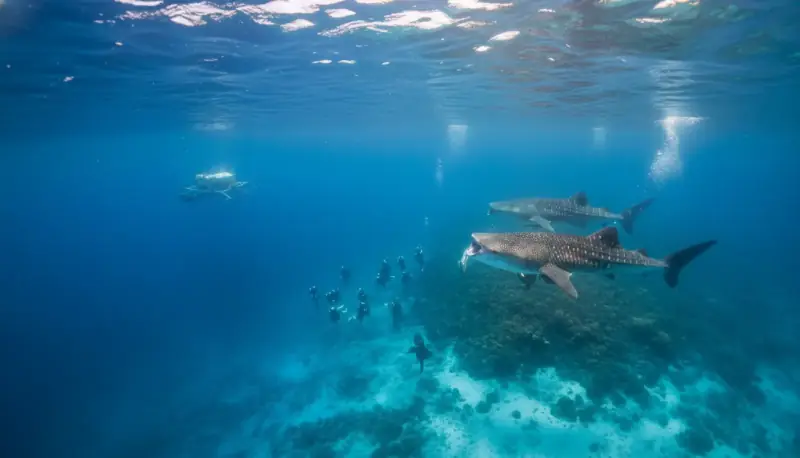
| Richelieu Rock | ~100 km northeast, inside Mu Ko Surin National Park (not the Similans). Thailand's premier whale shark site, best February–April. Reached on longer liveaboards |
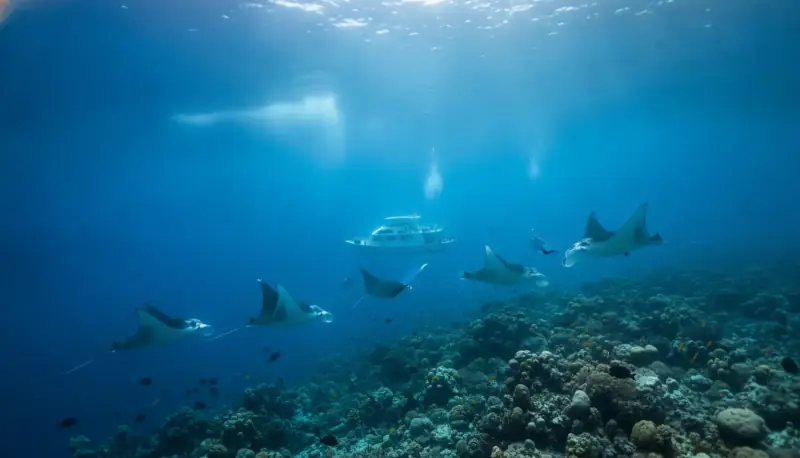
A few corrections to claims that circulate widely: hammerheads are not a Similan feature, the sharks here are whitetips, blacktips and leopard sharks. And mantas are not "routine", they're seasonal (roughly late January to April) and concentrated at Koh Bon and Koh Tachai, which is exactly why itineraries push north.
Beacon Reef, on Island 8, is currently closed for reef restoration and cannot be dived. (East of Eden and Anita's Reef are closed for the same reason.) Any guide still recommending them is out of date.
Park Fees and Rules
These are mandatory, frequently cash-only, and usually not included in your liveaboard price. Budget for them separately.
| Fee | Amount (foreign adult) |
|---|---|
| Park entry | 500 THB |
| Diving surcharge | 200 THB per diving day |
| Typical 4-day Similan + Surin liveaboard | Roughly 1,800–2,300 THB in park fees all in |
Two rules shape the whole experience:
A daily visitor cap of 3,850 people, administered through the DNP's e-ticket/permit system. This is why boats book out in peak season and why you cannot simply turn up.
No overnight stays on the islands, a ban in force since 2018. There is no camping and there are no bungalows. Licensed liveaboards are the sole exception, which is precisely why liveaboard is the standard way to dive here: the boat is your accommodation because nothing on land is.
Getting There
Fly into Phuket, transfer roughly 90 minutes north to Khao Lak, and board at Tap Lamu pier, the primary departure point for Similan liveaboards. Most operators bundle the airport pickup, a pre-trip night if you need it, and the transfer.
Trips typically run 4 days for the Similans proper, extending to 6–7 days when the itinerary adds Koh Bon, Koh Tachai and Richelieu Rock. The longer trip is what you want if whale sharks are the goal, because Richelieu is where they are.
Practical Notes
Dive insurance. Get a policy that explicitly covers diving, with emergency evacuation and repatriation. Your standard travel insurance very likely does not. Phuket and Khao Lak have dive medicine facilities; ask your operator about their evacuation protocol before you board.
Bring your own mask, computer, and fins if you can, in your carry-on. Rental quality varies, and familiar gear is one less variable on an unfamiliar site.
Buoyancy is a conservation issue here. The park has hard rules about coral contact, and the restoration closures at Beacon Reef and East of Eden exist because of cumulative diver damage. Stay off the reef, keep your fins up, and don't hold on to anything living.
Check conditions with your operator close to departure rather than trusting any month-by-month table, including this one. Weather in the Andaman turns on recent wind and swell, not on the calendar. What the calendar does tell you, reliably, is whether the park is open at all.