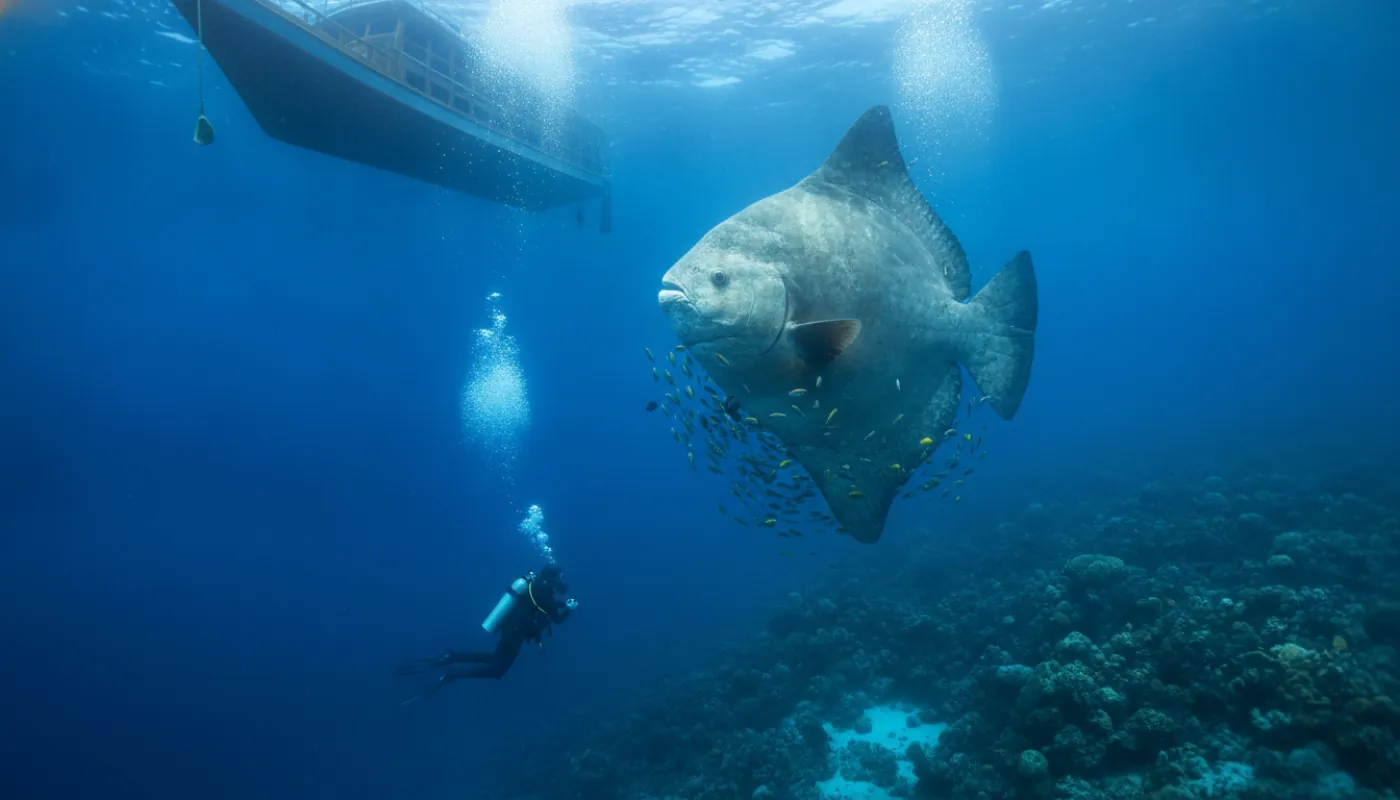
A sunfish is one of the strangest things you can meet underwater, an animal built like a dinner plate that someone attached fins to, hanging in cold blue water while small reef fish groom it. Nusa Penida is one of the few places on earth where you can plan a trip around seeing one.
It is also a genuinely dangerous dive, and this guide is going to spend real time on that, because the site that produces the sunfish is the same site that has killed divers.
First, the Fish Isn't What You Think
The sunfish at Nusa Penida is almost certainly not Mola mola.
DNA work on the Bali animals identified them as Mola alexandrini, the bump-head or southern sunfish. True Mola mola is rarely, if ever, seen here. The dive industry uses "mola mola" as a catch-all marketing label (and as the phrase everyone searches), but the animal you'll photograph is M. alexandrini.
And they don't come up to feed. This is the single most misunderstood thing about the dive, and it changes how you should behave in the water.
Sunfish feed deep, typically 90 to 170 metres, with recorded dives past 600. What brings them into recreational depths at Crystal Bay is the cleaning stations: they rise to hang, more or less motionless, while bannerfish and angelfish pick parasites off their skin, and they use the trip to warm up afterward. The cold upwelling isn't delivering their food. It's what lets a deep-water fish tolerate being shallow at all.
Once you understand that, the code of conduct stops being arbitrary. You are a visitor at a spa appointment. Get between the fish and the cleaning station, or spook it off, and you've taken away the only reason it came up.
The Season
July through October, with the peak generally August–September (some operators rate September–October the strongest of all). It tracks the southeast monsoon and the cold upwelling that comes with it.
Don't over-optimise the calendar. The old advice to "book mid-August because September declines" isn't supported, September is prime. What genuinely improves your odds is more days in the water: a single dive is a coin toss, while four or five dives across the season makes an encounter likely. Sightings are never guaranteed, and any operator who guarantees them is telling you something about themselves.
Crystal Bay: The Serious Part
Crystal Bay sits on Nusa Penida's west/southwest coast, at the southern end of the channel between Penida and Nusa Ceningan, a channel through which the Lombok Strait pushes an enormous volume of water.
That's the whole problem. This is not a site with "strong current" in the ordinary sense. The hazard at Crystal Bay is vertical.
Crystal Bay has killed divers. A death in 2011, and two more on consecutive days in 2012, after which the site was closed, all involving downcurrents, and there is a continuing history of decompression injuries from divers caught in a downcurrent and then making a panicked rapid ascent. Treat it accordingly.
Downcurrents and upwellings here are visible from the boat as swirling or "boiling" patches on the surface. They are strong, they are fast, and no amount of finning will out-swim them vertically.
If you are caught in a downcurrent:
- Stay calm and do not fight it upward. You cannot win that.
- Swim horizontally away from the wall or reef, into open water, angling up at roughly 45° if you can. The down-flow is strongest against the structure and weakens as you move away from it, that's your exit.
- Keep equalising on the way down. You may lose depth before you escape.
- Add gas to your BCD only as a last resort, and vent it immediately the moment you break free, or you will convert a descent into a runaway ascent, which is what has hurt people here.
- Watch your gas, and abort the dive.
Know that sequence before you get on the boat, not after.
Cold, Depth, and Why They Compound
| Condition | Reality at Crystal Bay in mola season |
|---|---|
| Water temperature | Thermoclines commonly 16–18°C, reported as low as ~15°C. Not "tropical" in any sense |
| Exposure | A hooded 5 mm is the minimum; 7 mm with hood and gloves is typical |
| Depth | Sunfish typically hold at 20–40 m |
| Visibility | Usually 20–30 m, the bay earned its name, dropping in plankton-rich water |
Look at the middle two rows together, because that's the trap. 40 metres is the absolute recreational limit (and 30 m is the AOW limit). At 30–40 m on air, your no-decompression limit is a handful of minutes. Add 16°C water (which drives up your gas consumption, adds task loading, and sharpens narcosis), and a strong current, and the margins that felt generous on a warm reef dive are gone.
This is why nitrox is the standard recommendation for this dive, and why Deep Diver training is worth having. Plan the dive as a deep, cold, current dive that happens to have a sunfish in it, because that's what it is.
Who Can Actually Do This Dive
Advanced Open Water is the floor, not the qualification. Operators running Crystal Bay and Blue Corner in mola season typically want AOW plus logged dives (commonly 30 minimum, and 50+ for the harder sites), plus demonstrable drift experience and honest buoyancy control.
(You'll sometimes read that "Rescue Diver" is the operator standard. It isn't. Logged dives and current experience are what they actually gate on.)
If you have twelve dives and a fresh AOW card, this is a dive to build toward, not to talk your way onto.
The Interaction Code
Nusa Penida's marine protected area publishes a code of conduct, and it exists because a spooked sunfish leaves and doesn't get cleaned.
- Keep 3 metres (about two body lengths) from a sunfish that is settled at a cleaning station.
- Keep 10 metres (five body lengths) if the animal appears unsettled.
- No flash photography. No touching, ever.
- Never swim beneath or directly behind one, your bubbles will drive it off.
- Never block its escape route off the reef, or the pathway onto the cleaning station.
- Limit your interaction to about five minutes when other groups are waiting.
Every one of those rules is really the same rule: don't cost the animal the thing it came for.
Logistics and Fees
Fees. Nusa Penida's MPA charges a conservation fee of IDR 100,000 (about US$6.50) per person for diving or snorkelling, in force since July 2023, on top of boat and port fees.
Getting there. Skip the liveaboard advice you'll read elsewhere, there is no meaningful Penida liveaboard fleet. The norm is day boats from Sanur or Padangbai, or basing yourself with a shop on Nusa Penida or Nusa Lembongan. Staying on the islands is the better play in season: shorter crossings, earlier starts, more flexibility when a day gets blown out.
Build a 4–5 day window and book two to three months ahead; the season fills with people chasing exactly the same fish.
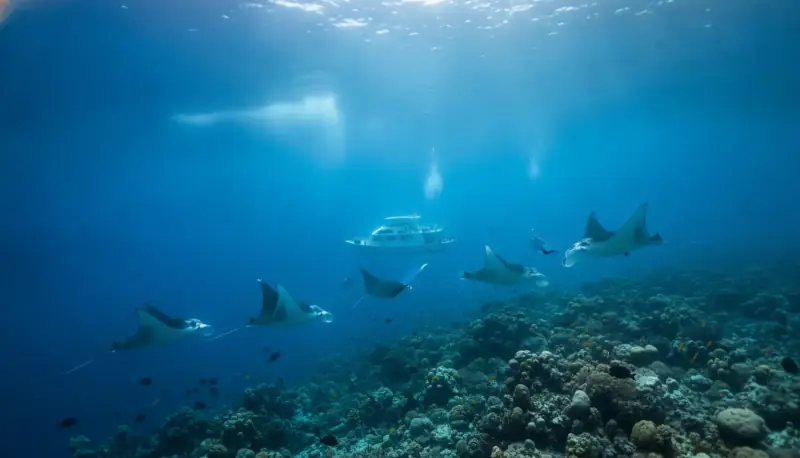
Plan contingency dives, but choose them carefully. Manta Point is a genuinely good alternative and far more forgiving. Batu Bolong (often misspelled "Batu Balong") is a real Penida site, but it's another deep, current-swept, 18–22°C advanced dive, so it's not a soft landing if conditions are already marginal.
Finally
Bring more thermal protection than you think you need, and dry clothes for the surface interval, you will be colder than a Bali trip has any right to make you.
Then do the boring homework: rehearse the downcurrent response, agree it with your buddy, know your gas plan at 35 metres, and settle your camera before you splash. A sunfish appears without warning and leaves the same way. The divers who come home with the encounter, and come home at all, are the ones who'd already handled everything else.