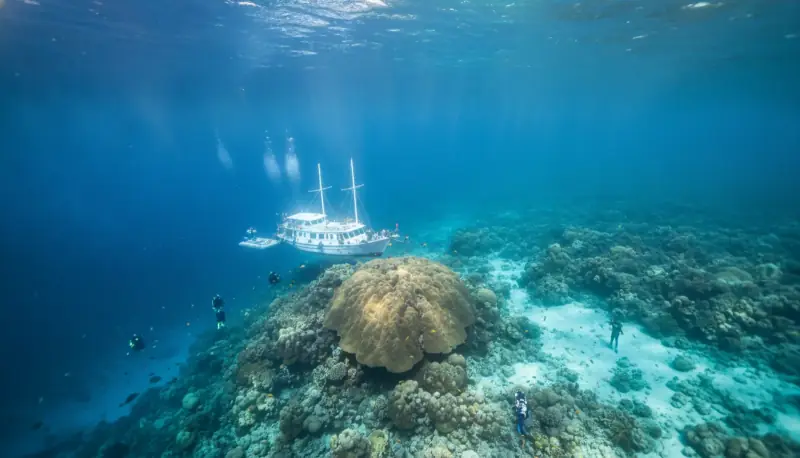
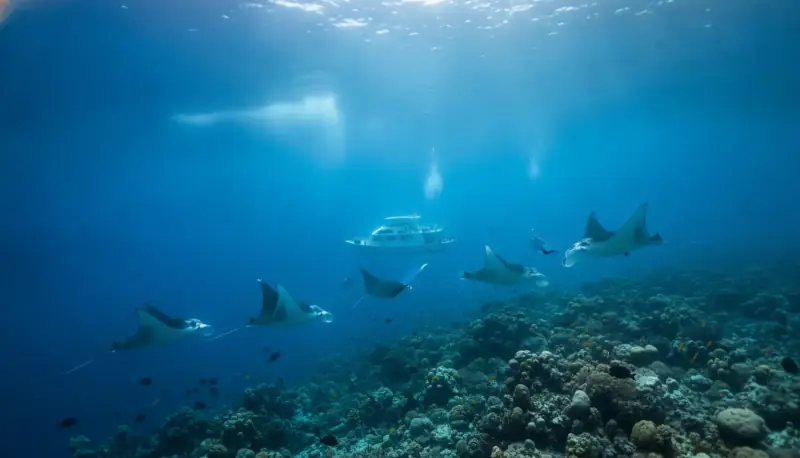
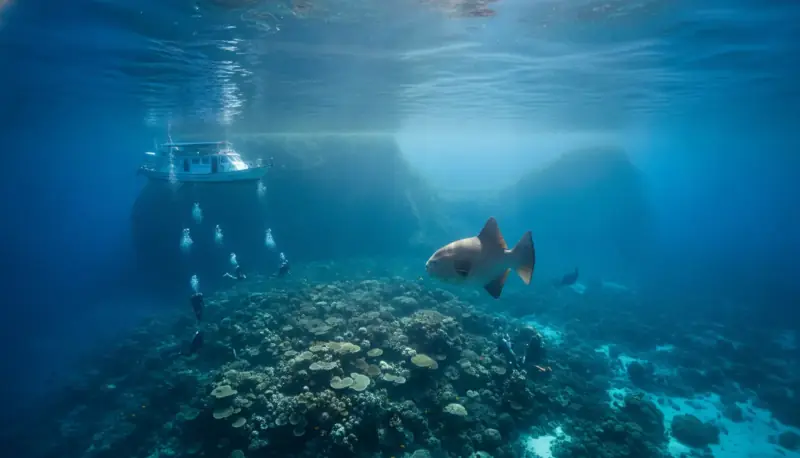
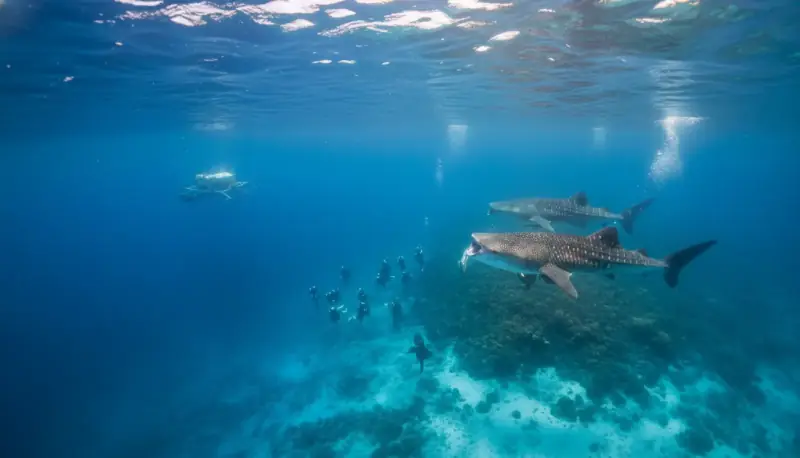
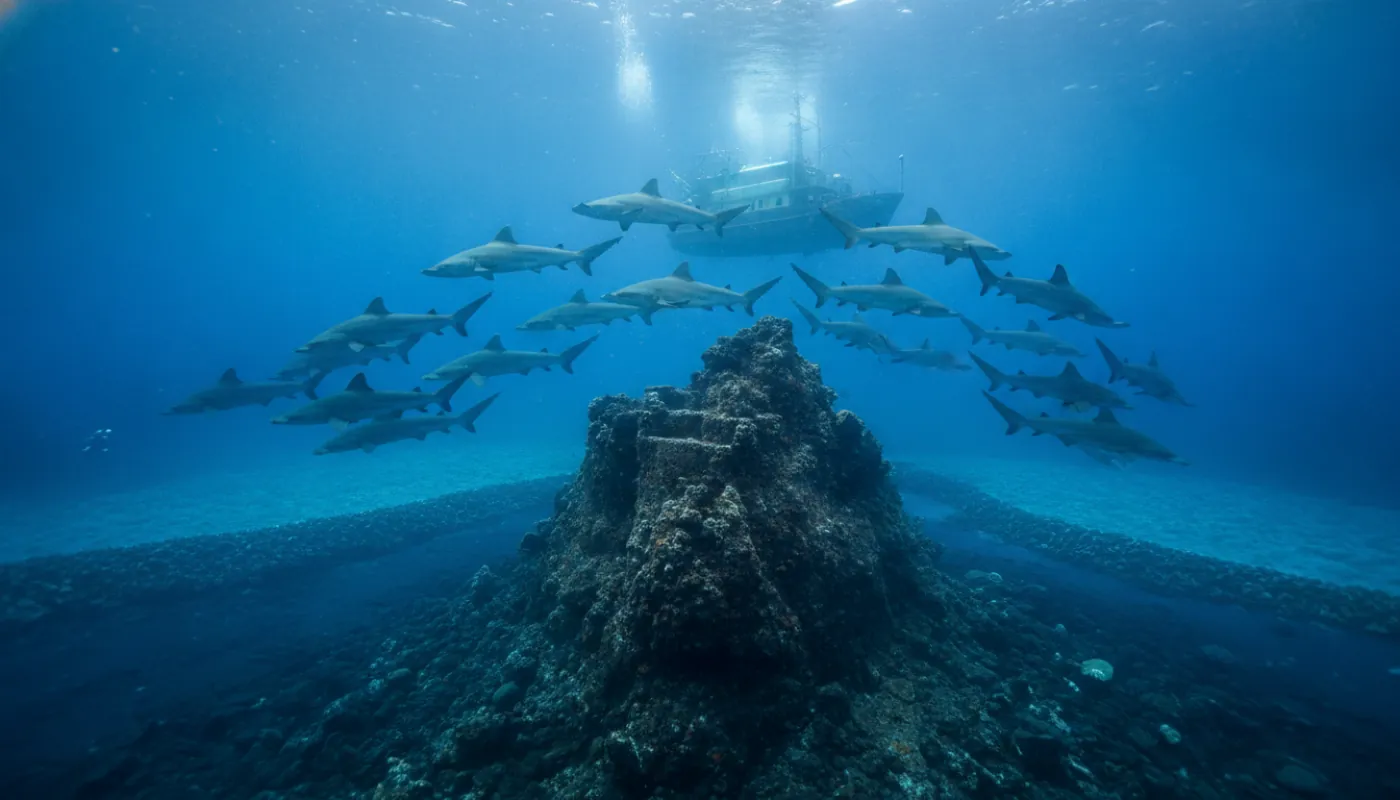
Schooling scalloped hammerheads in the hundreds, hanging in cold blue water off a bare volcanic rock a thousand kilometres from anywhere. This is the dive that sits at the top of most divers' lists, and it deserves to.
It is also the least forgiving trip in recreational diving, both to plan and to execute. Get the prerequisites wrong and you will be told, politely, on a boat you have already paid for, that you're not diving Darwin.
The Rules That Decide Whether You Can Go
Darwin and Wolf are liveaboard-only. This is the single most important planning fact and most guides bury it. No land-based day boat is permitted to dive them, there is no way to stay in a hotel on Santa Cruz and go see the hammerheads. You book a liveaboard or you don't go.
And the operators gate on experience. The near-universal requirement is:
| Prerequisite | The standard |
|---|---|
| Certification | Advanced Open Water or equivalent |
| Logged dives | Minimum 50, many operators want 60–100+ |
| Recency | At least one logged dive within the previous 6 months |
| Experience | Demonstrated strong-current and cool-water diving |
| Nitrox | Commonly required, not merely recommended |
Note what is not on that list: the Deep Diver specialty. It's a fine course, but it is not what operators check. Logged dives and current experience are the gate. Show up with a fresh Advanced card and 20 dives and you may find yourself snorkelling.
What It Costs
Budget honestly, because the real floor is higher than the internet's.
| Item | Real 2026 cost |
|---|---|
| Galápagos National Park fee | US$200 for foreign adults (doubled from $100 on 1 Aug 2024); $100 under 12; $30 for Ecuadorian nationals/residents. Cash USD, on arrival |
| Transit Control Card (TCC/TCT) | US$20, obtained at the INGALA counter in Quito or Guayaquil before your flight, not on arrival in the islands |
| 7-night Darwin/Wolf liveaboard | From roughly US$6,400, with most boats $6,500–7,500 |
| International + internal flights | Add roughly $1,000–2,500 |
No licensed Darwin/Wolf liveaboard sells for $3,500. If you see that number, you're looking at a different itinerary that doesn't go to the sharks.
Trip length is 7 nights / 8 days as standard, about six diving days and 19–20 dives. Ten-night trips exist but are the exception. And book far earlier than you think: peak Darwin/Wolf berths routinely go 12–18 months out.
When to Go
The hammerheads are a cool-season phenomenon, driven by the Humboldt upwelling.
| Season | What happens |
|---|---|
| June–November (garúa, cool, dry) | Peak hammerhead season. Strongest upwelling, biggest schools. Also whale shark season at Darwin (large, likely-pregnant females), most reliable July–October |
| December–May (warm, wet) | Warmer, clearer, calmer, but the big schools thin out as the water warms |
Water temperature is the thing people underestimate. Surface temps at Darwin and Wolf run roughly 22–26°C in the cool season, but thermoclines and the central-island sites drop to 16–18°C. That cold spike is exactly what your 7 mm suit, hood and gloves are for. Visibility is typically 15–30 m, and it can drop sharply when the upwelling is running hard.
Darwin and Wolf
Two things to correct straight away, because they're widely garbled.
Darwin is the northernmost point of the entire archipelago: Wolf lies about 40 km to the southeast of it, and Wolf is the larger of the two islands, not the smaller. And there is no continental shelf here: the Galápagos are oceanic volcanic islands, and Darwin and Wolf are the exposed summits of the Wolf–Darwin Lineament, rising straight out of deep water. That's precisely why the pelagics are there.
Darwin. The famous arch collapsed in May 2021 and is now two stubs known as the Pillars of Evolution, but the dive is unchanged. You work the edges of the submerged platform, hold position in current, and wait for the schools to come off the blue. It's the hammerhead site.
Wolf. Deeper wall and canyon diving, more exposed to swell and current, and generally a step up in demand. Galápagos sharks (circumtropical, despite the name), silky sharks, big schools of jacks and tuna.
The captain and divemaster decide whether the conditions allow entry, and on some days the answer is no. Flexibility matters as much as skill.
What the Diving Is Actually Like
You will descend, get low, tuck in against the rock out of the worst of the flow, and wait. The hammerheads pass in loose formation, some distance off in the blue, in ones and tens and sometimes hundreds. They are not interested in you. Blow a cloud of bubbles at them and they'll fade back into the blue, so divers hold still, breathe slow, and let the sharks come.
Be realistic about the demands. The current can be relentless and is often the hardest part of the day. You'll be cold. Bottom time is tempting at depths where your NDL is short, and staying deep to squeeze out one more pass is exactly how a recreational dive turns into an unplanned decompression obligation. Plan the dive, watch your computer, and go up when it says so.
Nothing about this is a relaxing reef dive. It's an athletic, absorbing, occasionally intimidating dive that repays every hour you spent preparing.
The Sharks Are in Trouble
Worth knowing what you're looking at: the scalloped hammerhead is IUCN Critically Endangered. Overfishing and finning have collapsed populations globally, and the Eastern Tropical Pacific corridor these animals migrate along (between Galápagos, Cocos and Malpelo), remains under pressure from illegal fishing right up to the reserve boundaries.
The schools at Darwin are one of the last great aggregations left. Diver dollars are a meaningful part of the argument for protecting them, and that's not a small thing to be part of.
Preparation
- Nitrox. Get certified before you come; it's commonly required and it buys you bottom time where you want it.
- Thermal protection. A 7 mm with hood and gloves. Come warm; you cannot fix cold at 25 metres.
- Redundancy. A backup computer, a backup mask, a cutting tool, and a good SMB with a long spool, you may surface far from the boat in open ocean.
- Seasickness medication. The crossings to Darwin and Wolf are long and can be rough.
- Service your gear at home, before you fly. Don't hand your regulator to a strange shop days before a remote trip, that's how you end up diving unfamiliar, freshly-disturbed equipment in the worst possible place to discover a problem. Tanks are supplied by the boat.
- Insurance that explicitly covers diving and remote marine evacuation. Check the exclusions; some policies carve out exactly this kind of trip.
Then get on the boat. When the first school materialises out of the blue and keeps coming, you'll understand why people book this trip a year and a half out.