The Maldives holds the largest reef manta population on earth (roughly 5,000 individually identified animals), and in the right place at the right time you can watch a hundred of them feed at once.
Getting that right depends on understanding two things that most guides state incorrectly: the rules at Hanifaru Bay, and which way the mantas actually move when the monsoon turns.
Hanifaru Bay: Snorkel Only. No Exceptions.
Start here, because a reader could otherwise arrive with tanks and be turned away.
Scuba diving is banned at Hanifaru Bay. It is a snorkel and freedive site only. Any advice about "maintaining neutral buoyancy and staying still on the bottom" at Hanifaru is describing an activity that is illegal there.
The ban exists for a good reason: bubbles and a scattered line of scuba divers break up a feeding aggregation. On the surface, floating still, you watch the whole thing happen beneath you: which is also, by common consent, the better view.
The site is a core marine protected area (protected since 2009) inside Baa Atoll, a UNESCO Biosphere Reserve (designated 2011). It is actively ranger-managed, and the rules are enforced:
| Rule | The specifics |
|---|---|
| Permit | Required. Entry is managed by EPA Biosphere Reserve rangers on site |
| Fee | Roughly US$20–30 per person (Baa Atoll Conservation Fund); tokens from the Hanifaru Visitor Centre at Dharavandhoo |
| Vessels | Five vessels inside the bay lines at any one time, not five per day, with entrance days alternated between liveaboards and resort boats |
| Time | 45 minutes in the water per group, once per day |
| Guides | A licensed Hanifaru guide is mandatory, maximum 10 snorkellers per guide |
| In-water cap | Limited (reduced in recent years to around 45 people) |
And Hanifaru is not day-trippable from Malé, it's about 120 km away. You reach it from Baa Atoll resorts or Dharavandhoo guesthouses (a 25-minute domestic flight to Dharavandhoo), or on a liveaboard with an allotted entrance day. A guide that has you booking a Malé hotel and hoping is sending you somewhere you cannot get to.
Finally, temper the "hundreds of mantas daily" line. The big aggregations are episodic, tied to spring tides and the lunar cycle, and the truly enormous days, on the order of 200 animals, are the exception rather than the rule. A week with Hanifaru on the itinerary in the season gives you a strong chance. It doesn't give you a guarantee.
The Monsoon Geography Everyone Gets Backwards
Here's the fact that reorganises the whole trip: when the monsoon switches, the mantas move from one side of an atoll to the other, east to west. They do not migrate north.
| Monsoon | Months | Where the mantas are |
|---|---|---|
| Hulhangu (southwest) | roughly May–November | The eastern sides of the atolls. Hanifaru sits on Baa's eastern rim, this is its window |
| Iruvai (northeast) | roughly December–April | The western sides of the same atolls |
So the mantas don't leave Baa in January. What stops is the Hanifaru feeding aggregation specifically; the animals redistribute to the western side of the atoll, and manta diving in the Maldives continues year-round, you just change which side of the reef you dive.
Where the Oceanic Mantas Actually Are
Two species, and they are not distributed the way most articles claim.
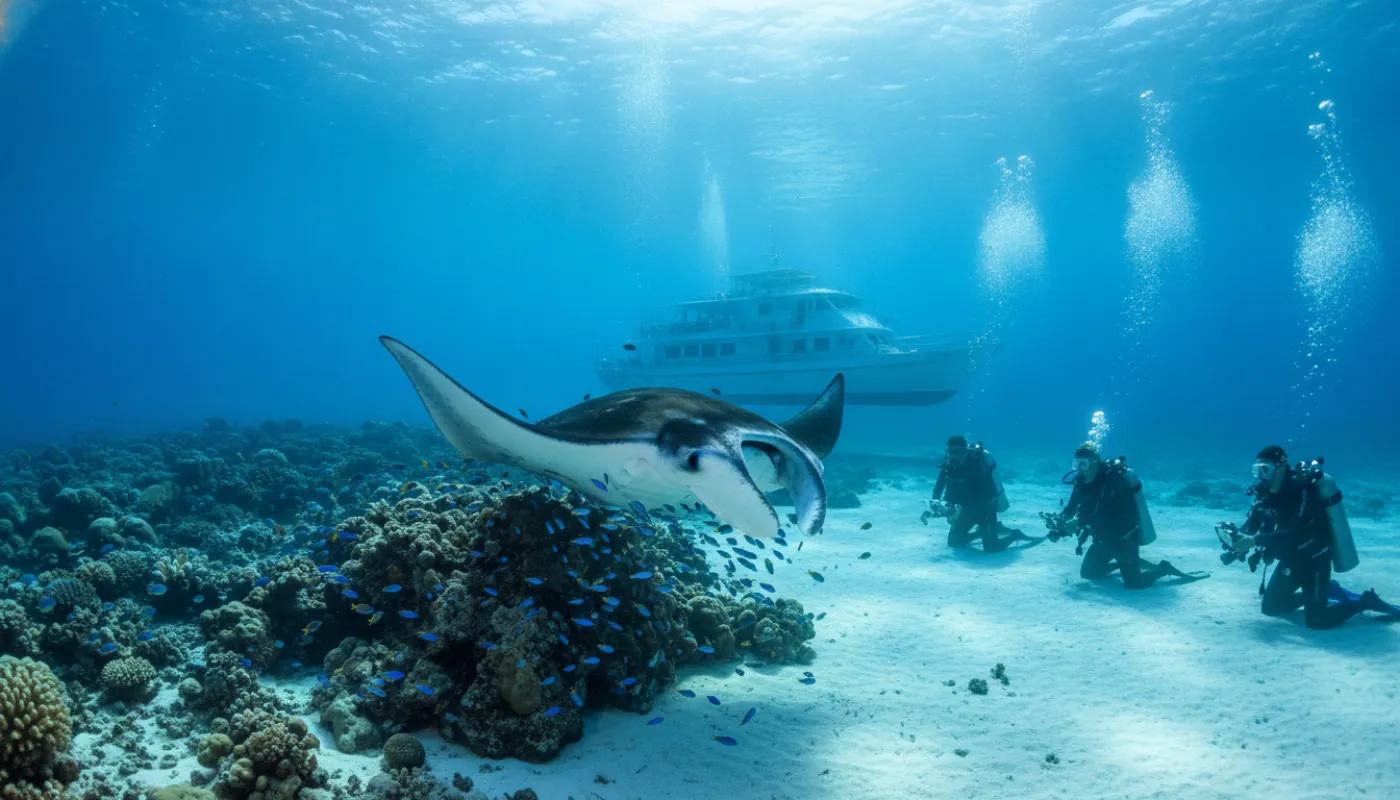
Reef manta (Mobula alfredi), the resident staple. Wingspan around 11–15 feet. IUCN Vulnerable. These are the mantas of Hanifaru, of the cleaning stations, of the high-count days. Book your trip for these.
Oceanic manta (Mobula birostris), much larger (to around 7 m / 23 ft), and genuinely rare. IUCN Endangered. And crucially: they do not aggregate at the Malé atolls. More than 85% of all oceanic manta sightings in the Maldives come from Fuvahmulah, in the far south, it's essentially the only place they're seen with any regularity. The Malé sites that produce mantas from December to April are reef manta cleaning stations, not oceanic ones.
(All mantas are legally protected in Maldivian waters.)
The Atolls
Baa Atoll, Hanifaru, and the headline. Southwest monsoon, roughly May to November.
South Ari Atoll, a genuinely good manta destination, whose main cleaning station is Rangali Madivaru. (Note: Vaavu and Boduhithi are not in South Ari, despite what you'll often read, Vaavu is its own atoll some 64 km from Malé, and Boduhithi is in North Malé. Anyone placing them in South Ari is copying an error.)
North and South Malé: central, not northern, with reef manta cleaning stations that come alive in the northeast monsoon.
Fuvahmulah, the far south, and the oceanic manta destination. Also a serious shark site, and a different kind of trip.
The Code of Conduct
Non-negotiable, and it's the Manta Trust code that operators across the country use:
- Enter the water no closer than 10 metres from a manta.
- Never approach closer than 3 metres. Let them come to you, they usually will.
- Never touch, and never chase.
- Don't block their path, and don't swim over the top of them.
- On snorkel: keep your fins below the surface, thrashing drives them off.
- On scuba at a cleaning station: stay to the side, low, and still. Never hover over the cleaning area itself; you're occupying the space the manta needs.
The recurring theme, as with every megafauna encounter: the animal is there for a reason that isn't you, and your job is to not take that away.
Costs and Logistics
Liveaboards run roughly $2,500–6,000 for a week or so, depending on the boat.
Then the mandatory extras, which trip up budgets:
- Green Tax: US$12 per person per night at resorts and on liveaboards (US$6 at guesthouses with 50 rooms or fewer).
- 16% T-GST on top.
- The Hanifaru entry fee, if it's on your itinerary.
Certification. Advanced Open Water is commonly recommended for the current-swept channel (kandu) dives, but it isn't a universal requirement, several operators accept Open Water divers with a logged-dive minimum. Nitrox is worth having for the deeper channels.
Fly into Malé, then take a domestic flight or speedboat to your boat or island. Pack seasickness medication and take it before you need it, not after.
The Short Version
Come May to November and get on an itinerary with a Hanifaru entrance day, understanding that you'll be snorkelling it, that you get 45 minutes, and that the truly enormous days are luck.
Come December to April and dive the western sides of the atolls for cleaning-station mantas instead: quieter, still excellent, and nobody will tell you the mantas "went north," because they didn't.