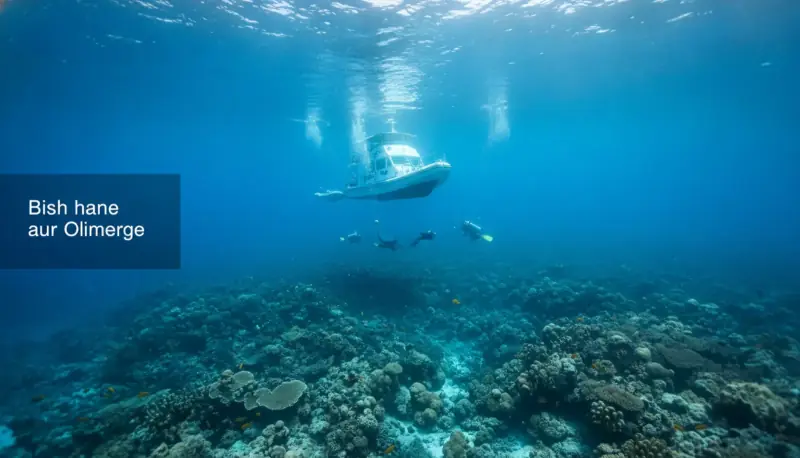
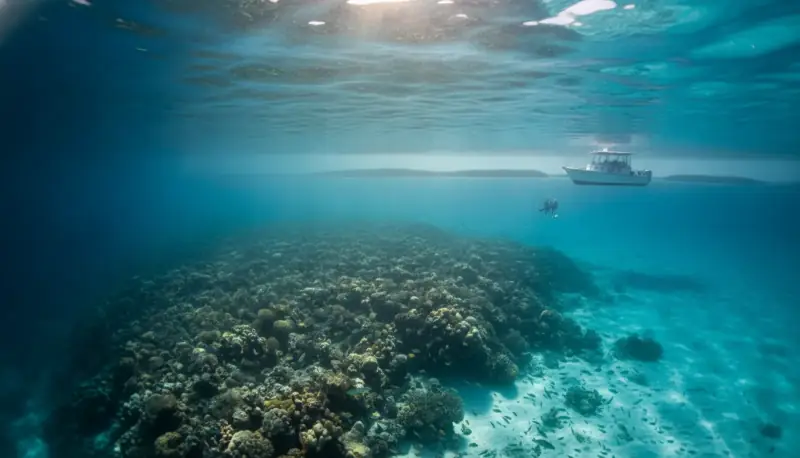
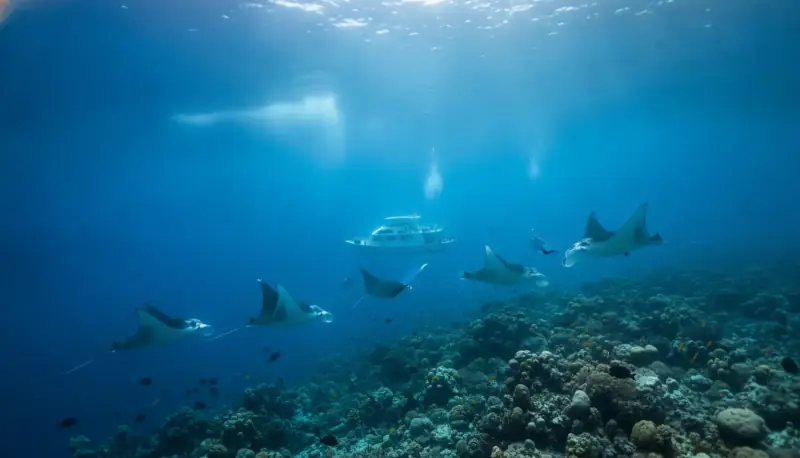
Drift diving isn't a specialized trick, it's the price of admission to some of the best diving on earth. From Komodo to Palau to Cozumel and the Red Sea, the reefs that teem are the reefs that are fed by moving water, and you don't get one without the other.
The core idea is simple: stop swimming and let the ocean carry you. Done properly, a drift dive is the least strenuous diving you will ever do: you hang in the water, the reef slides past, and you breathe less gas than you would hovering. What makes drift diving demanding isn't the effort. It's that the water is now in charge of where you go, which means the whole discipline is about staying findable and knowing what to do when the current does something you didn't plan for.
That last part is where this article spends most of its time, because that's where people get hurt.
Reading the Current
Current is measured in knots, and the numbers matter more than most divers realize, because a human being is a very weak swimmer.
| Current | What it means for you |
|---|---|
| Under 1 knot | Comfortable. You can still make headway if you need to |
| ~1 knot | DAN's threshold: don't dive stronger current than this without specific training |
| 1–1.5 knots | About the maximum a fit diver can generate by finning. At the top of this range you cannot make progress against the water |
| 2–3 knots | Genuine drift territory (a running day in Cozumel). You go where the water goes |
| 3–5 knots | Komodo and Palau passes. Expert conditions, guided, with a plan for every contingency |
Internalize the middle row: your top swimming speed is roughly the speed of a moderate current. Once the water is moving faster than about a knot and a half, "just swim back" has stopped being an option that exists. Every good decision in drift diving flows from accepting that early.
Read the water before you're in it. Watch how the boat sets up its approach. Look at the surface for texture, streaming, and the angle of any moored lines. Once you're down, watch the soft corals and sea fans, they lie over in the direction the water is going. Current also changes with depth and along the reef: it can rip along the wall and go slack in the lee of a headland, and it can shear, running one direction at 20 metres and another at 10.
Note that current is not necessarily where the reef is prettiest. It's where the reef is alive: the flow brings the plankton that brings everything else.
The Entry: Go Negative, Go Together
This is the first thing many drift articles get backwards, and it strands beginners on the surface.
A drift entry is a negative entry: BCD fully deflated, everyone enters on the divemaster's signal, and you descend immediately and together. You are not stopping at the surface for a chat. A surface current can be running faster than the current below it, and a group that pauses on top gets scattered and blown off the site before anyone reaches the reef.
So: gear checked on the boat, air on, computer on, BCD empty, in on the signal, and down. Get neutral once you're at working depth, not before.
In the Water: Do Nothing, Well
Once you're down and neutral, the technique is mostly restraint.
Stop finning. Let the water do the work. This is the single reason a drift dive is such a gas-efficient dive, you're not swimming, so you're not breathing hard. If you find yourself finning, ask what you're finning for.
Stay in trim and stay off the reef. Your fins are for small corrections and staying horizontal, not for fighting anything. A diver flailing to hold position in current is also a diver kicking coral to pieces.
Stay tight with your buddy and your group. In a drift everyone moves at the same speed, so staying together is easy, right up until someone drops behind a bommie into slack water and pops out somewhere else. Check on each other constantly.
Watch your gas anyway. Efficient doesn't mean free.
Vertical Currents: The One That Can Kill You
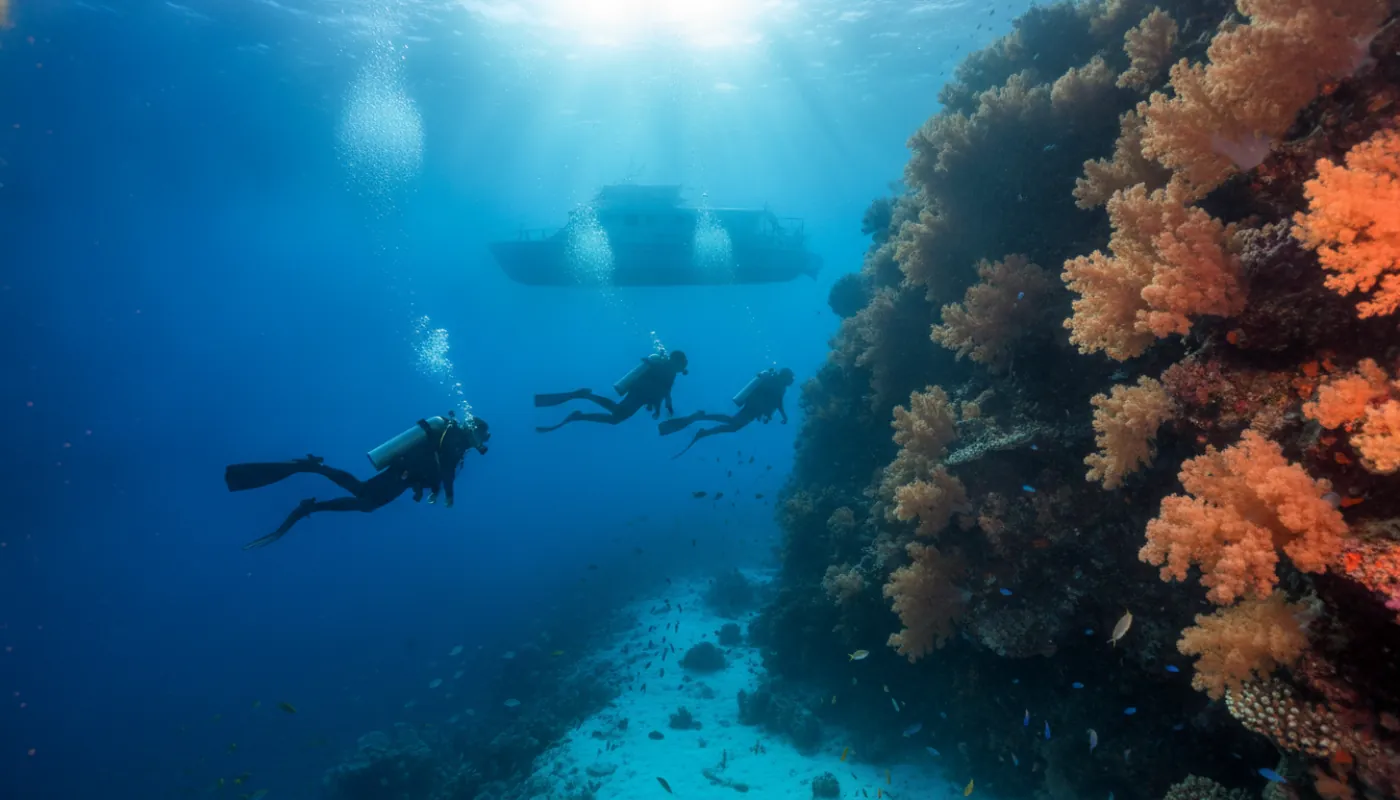
Horizontal current carries you somewhere. Vertical current takes you somewhere you didn't agree to go, and it's the scenario that turns a nice drift into an emergency.
A downcurrent happens where moving water hits a wall or a drop-off and is deflected downward. It is strong, stronger than you can swim, but it is usually narrow. That geometry is the entire escape plan.
If you are caught in a downcurrent, do not ride it and do not try to swim straight up. Swim horizontally, away from the wall, angling slightly upward if you can, to get out of the narrow band of descending water. Add gas to your BCD to help arrest the descent, and be ready to dump it the instant you break free, or the buoyancy that saved you becomes a runaway ascent. If the wall offers solid, dead rock to hold, DAN's guidance is to grab on and wait it out.
An upcurrent is the mirror image and the response is the opposite: vent your BCD completely, keep exhaling continuously, and swim horizontally out of it. Never let an upcurrent take you, an uncontrolled ascent risks lung overexpansion injury and decompression sickness.
Notice what's true of both: you escape sideways, not vertically. You cannot out-swim a vertical current going up or down, but you can get out of its way, because it's narrow.
Some destinations solve this problem with a reef hook: a hook on a short line, clipped to your BCD, that lets you tether into the reef and hang like a kite in ripping current. This is standard practice at places like Blue Corner in Palau. Two rules: hook into dead rock or dead coral only, never living coral, and keep the hook-in short. A reef hook parked in a living reef is just vandalism with extra steps.
The DSMB Is Your Lifeline
Your delayed surface marker buoy is how the boat finds you. In a drift, you will surface somewhere other than where you went in, possibly a long way away, possibly in chop. The DSMB is the difference between a pickup and a search.
Deploy it at your safety stop, around 5 metres, and get it up before you break the surface, not after.
The rule that matters most: never clip or wrap the spool, reel, or line to yourself or your BCD. If the spool jams, or a boat or a passing diver snags the line, a tethered diver gets yanked to the surface in an uncontrolled ascent. Hold the spool in your hand so you can let go of it. Sacrificing a spool costs about twenty dollars. The alternative costs considerably more.
The deployment sequence:
- Look up. Check the water column above you is clear of divers, lines, and the boat.
- Unclip nothing to yourself. Spool free in your hand.
- Fill and release, keeping the line running freely off the spool.
- Keep the line taut and away from your body as it runs out, so it can't loop around you or your gear.
- Ascend under it, reeling in, holding your safety stop.
Carry more line than your depth, a 30-metre spool is a sensible minimum. There is no rule against a "full" reel, and reels do not "collapse", the real hazard is entanglement, not slack.
If You Lose Your Buddy
The standard protocol, and it is standard for a reason:
Search for no more than one minute. Then ascend slowly, take your safety stop, and reunite on the surface.
That last clause is the whole point of the rule, and it's the one people forget. You do not go hunting at depth. You do not stage a partial ascent and hover around looking. In a drift you and your buddy are being carried at the same speed by the same water, so the sooner you both surface, the closer together you'll be. Every minute you spend searching at depth is a minute the gap widens.
Never swim back against the current to look for someone. You can't, and you'll burn the gas you need for a controlled ascent trying.
Gas Planning: There Is No "Turnaround"
Be careful with advice imported from other kinds of diving. On a reef dive from a fixed mooring you turn the dive at a set pressure and swim back. In a drift dive there is nothing to turn back to. The boat is going to collect you downcurrent from where you started.
So the gas rule isn't a turnaround, it's an ascent trigger. At your agreed pressure, you signal, deploy the DSMB, and go up. That's it. (DAN points divers toward a reserve discipline like the rule of thirds for planning the margin.)
Telling a new drift diver to "turn around at 100 bar" is worse than useless: it invites the single most dangerous mistake in current diving, which is trying to swim upcurrent.
Getting Picked Up: Signal Correctly
Surface signals are not improvised, and one common piece of misinformation is genuinely dangerous here.
| Signal | What it actually means |
|---|---|
| Arms/one arm waved overhead at the surface | DISTRESS, I need help. This is a rescue signal. Never use it to mean "I'm fine" |
| Arm curved into an "O" over the head, or hand tapping the head | OK / I'm fine, this is how you tell the boat you're all right |
| Closed fist (underwater) | Stop / hold |
| Flat hand rocked side to side (underwater) | Something's wrong / problem |
Get this the right way round before you get in the water. A diver waving cheerfully at the boat to say "all good" has just told an experienced crew that they are in trouble.
Beyond the DSMB, carry two signalling devices, at least one audible and one visual. A whistle on your BCD costs nothing. A mirror, a strobe, or a VHF/PLB unit extends your range enormously when you've surfaced far from the boat in swell. The DSMB is your primary; these are what you have left when the boat still hasn't seen you.
And when the boat does come: never approach it with the engines in gear. Propeller strikes and entanglement are real. Wait, let them come to you, and board on their signal.
Getting Trained
Drift diving is a genuine specialty, and both major agencies teach it: PADI's Drift Diver course (open to Open Water divers from age 12, two open-water training dives, covering floats, lines and reels, buoyancy, communication, and staying with the group) and SSI's Waves, Tides and Currents. Either one gives you the DSMB reps and the current-reading practice in controlled conditions, which is exactly where you want your first fumbled deployment to happen.
A closing note on depth: this is a beginner's guide, and an Open Water diver's limit is 18 metres. Plenty of world-class drift diving happens well within that. Don't let a dive guide's plan quietly walk you past your certification, and don't let the excitement of a ripping wall talk you into a depth you haven't trained for.
Drift diving rewards calm. Read the water, go in negative, stop swimming, stay findable, and know your escape from a downcurrent before you ever meet one. Then enjoy the best ride in diving, and explore the destinations where the current is the whole point.