Skip to content
Top-rated outdoor gear, ranked

Best Of 2026

Best Dive Lights of 2026

Our top 10 picks, independently ranked. Budget to premium.

A good dive light does something no other piece of gear can: it gives you back color. Below 30 feet, reds and oranges have already drained out of the reef, and by recreational depths the whole scene shades blue-gray. A torch restores that color on demand, lets you peek into the cracks and overhangs where the interesting animals actually live, doubles as a signaling device to your buddy, and turns an ordinary daytime dive into a viable night dive. For most recreational divers it is the single most quality-of-life-improving accessory after the regulator and computer.

The market splits cleanly into tiers, and the tiers matter more than the brand names. At the bottom, $40–$80 buys a genuinely usable 1,000-lumen aluminum torch that will outperform anything you owned a decade ago, perfect as a backup or a first primary. The $120–$270 middle is where most divers should shop: brighter output (1,300–3,000 lumens), better switches, real rechargeable battery systems, and the durability to survive saltwater and boat decks for years. Above $500 you reach canister and high-output video/tech lights that throw 4,600–9,000 lumens with multi-hour burn times, magnificent, but more light than open-water recreational diving needs.

This guide spans that whole spectrum on purpose. Lumens are not the only number that matters: beam angle, burn time, switch design, and whether the battery is a proprietary brick or a standard cell all shape how a light feels in the water. The picks below are chosen so that whether you want a $45 pocket backup or a $700 statement light, you can see exactly what you are trading away by moving up or down the price ladder.

At a glance

AL1300NP 1300-Lumen Narrow Beam
Best OverallMid-range

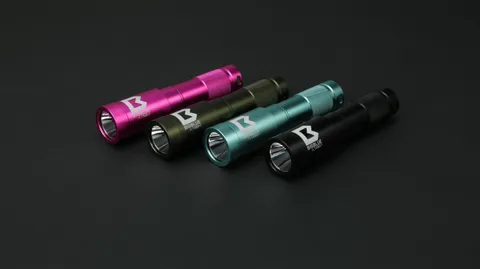
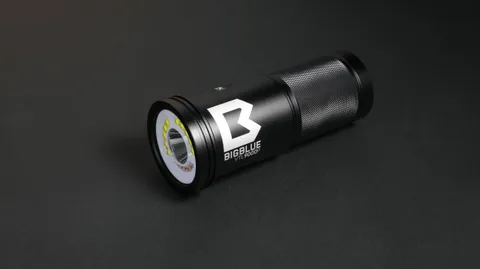
1. AL1300NP 1300-Lumen Narrow Beam

Bigblue

$150–$180

An eight-year best-seller for good reason: a tough, simple, ideally-sized narrow-beam primary that hits the recreational sweet spot of brightness, burn time, and price without any fuss.

Best for: The diver who wants one do-everything primary that just works

Proven, reliable design with a loyal following · Four power levels (1300–130 lm) give 2–20 hours of burn · Focused 10° beam cuts through murk and signals well · Rugged anodized aluminum, 100 m depth rating

Narrow-only beam is not ideal for video or wide scenes · Single-button interface cycles through SOS to reach off

D710 3000 Lumens Dive Light
Best ValueMid-range

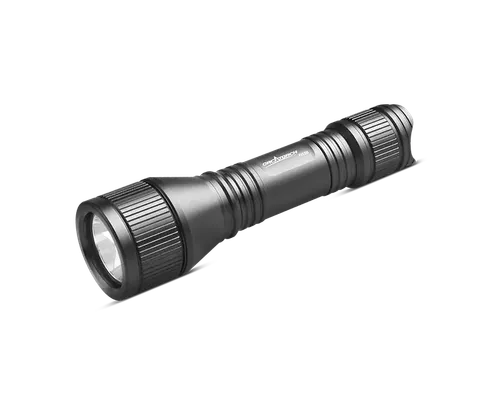
2. D710 3000 Lumens Dive Light

OrcaTorch

$130–$160

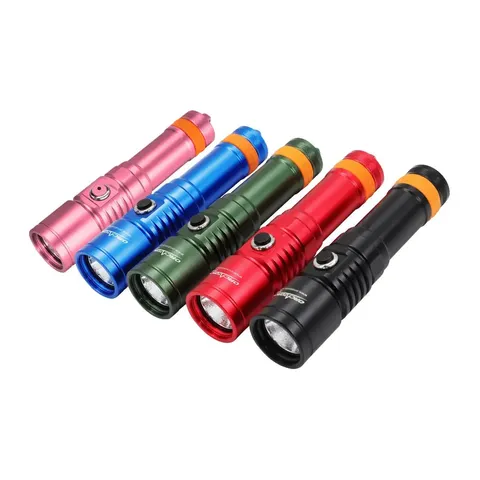
Three thousand lumens, a 21700 USB-C battery, and a glove-friendly rotary switch for around the price of many 1,000-lumen lights, the standout value pick in the lineup.

Best for: Divers who want maximum brightness-per-dollar in a compact primary

3000 lm turbo plus usable high/medium/low modes · Single 21700 5000mAh cell with Type-C charging · Tight 6° beam excellent for night dives and signaling · 150 m depth rating for a recreational-priced torch

Turbo mode steps down on heat and burns the battery fast · Narrow beam is too tight for video work

Nova 850R Dive Light
Editor's PickMid-range

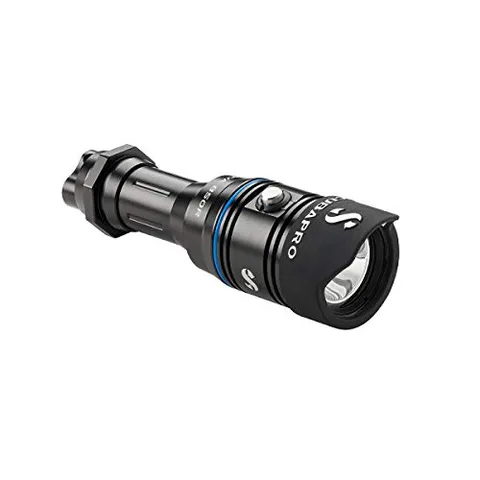
3. Nova 850R Dive Light

Scubapro

$160–$220

Not the brightest here, but arguably the best-built: a machined-aluminum 850-lumen torch from a trusted scuba brand, with a safety over-pressure valve rarely seen at this price.

Best for: Divers who prioritize build quality and brand reliability over raw lumens

Excellent build quality and a brand with real dive-shop support · 850 lm / 17,000 lux with a clean, even beam · Over-pressure valve vents battery off-gassing, a genuine safety feature · 150 m depth rating, compact and travel-friendly

850 lumens is modest next to newer 3,000-lm rivals · ~2-hour burn on full power on the single 18650 · You pay a premium for the Scubapro name

D520 1000 Lumens Dive Light
Best BudgetBudget

4. D520 1000 Lumens Dive Light

OrcaTorch

$40–$55

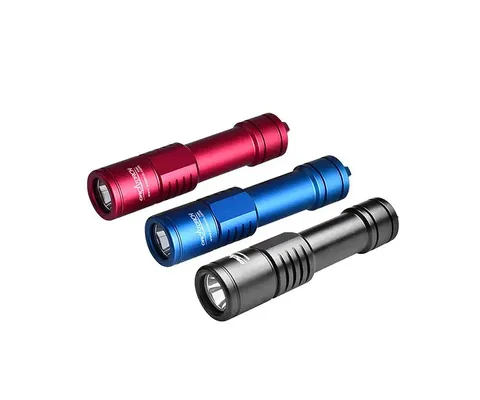
The default recommendation for a first light or a backup: a palm-sized 1,000-lumen aluminum torch with a tactile mechanical rotary switch, for the price of a couple of tank fills.

Best for: First-time buyers and anyone needing an affordable backup light

Genuinely useful 1000 lm in a pocketable body · Mechanical rotary on/off is reliable and glove-friendly · 150 m depth rating despite the low price · Makes an ideal backup once you upgrade

~2-hour runtime and no intermediate modes · Fixed beam, no adjustability · Charger/battery quality is basic

EOS 20LRZ Dive Light
Mid-range

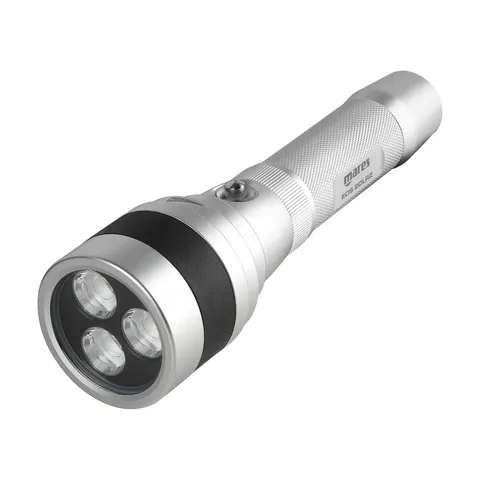
5. EOS 20LRZ Dive Light

Mares

$200–$270

A bright, adjustable-beam 2,300-lumen primary from a mainstream scuba brand, with a magnetic focus you can change underwater and a sealed rechargeable battery you never remove.

Best for: Divers who want one adjustable beam for both critter-hunting and wide scenes

2300 lm with magnetic focus from 12° spot to 75° flood underwater · Sealed battery charges via the tail, no O-ring fumbling · Strong recreational night-dive primary with even output · Backed by a widely-stocked dive brand

Large, heavy, and bulky compared to rivals · ~100-minute burn time on full power · Long full recharge time

Fusion 1000 Video LED Dive Light
Mid-range

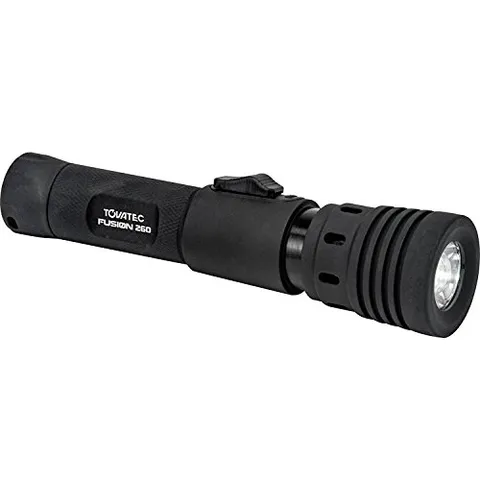
6. Fusion 1000 Video LED Dive Light

Tovatec

$110–$140

A versatile slide-focus torch that morphs from a 12° spot to a 100° flood, doubling as a budget video light and a backup small enough to stash in a BC pocket.

Best for: Divers who want one light for video, wide scenes, and backup duty

Adjustable 12–100° beam covers spot, flood, and video · 1000 lm with ~3.5-hour runtime on the 26650 cell · Runs on AA alkalines in a pinch as a backup · Compact and light for travel

1000 lm is modest for a wide-flood video setting · Slide-focus mechanism needs rinsing to stay smooth · Not the brightest at this price anymore

DL40 5000-Lumen Dive Light
Budget

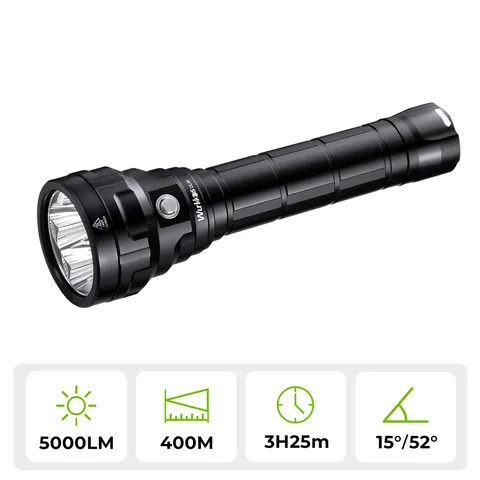
7. DL40 5000-Lumen Dive Light

Wurkkos

$55–$80

A flashlight-enthusiast favorite: high-CRI 5,000-lumen output and solid build for well under $80, the budget bright-light bargain, provided you accept it's not a heritage dive brand.

Best for: Budget-minded divers and flashlight enthusiasts who want maximum lumens cheaply

Big 5000 lm burst from four high-CRI LH351D LEDs · Excellent 90 CRI 5000K color rendering for the price · Hard-anodized aluminum body, double O-rings, 150 m rated · Runs on standard 26650/18650 cells

Output sags hard after the first few minutes on turbo · No dive-industry service/warranty network behind it · Larger and heavier than its lumen-peers

D550 1000 Lumens Dive Light
Budget

8. D550 1000 Lumens Dive Light

OrcaTorch

$60–$80

A slim 1,000-lumen torch with a tail magnetic switch and a standout 4+ hour low-mode runtime, purpose-built to be the dependable backup clipped to your BC.

Best for: Divers wanting a long-burning, glove-friendly dedicated backup

Tail magnetic switch is easy with thick gloves · Over 4 hours of burn on low (380 lm) · Compact and light, ideal pocket backup · High/low plus a strobe mode

1000 lm max is fine for backup, modest as a primary · Magnetic switch can be bumped on if stowed carelessly · Only two output levels

VTL9000P Dual-Beam Video & Tech Light
Best PremiumPremium

9. VTL9000P Dual-Beam Video & Tech Light

Bigblue

$700–$900

A do-it-all powerhouse that fires a 9,000-lumen 120° flood for video and a 1,200-lumen 10° spot for cutting through water, far more than recreational diving needs, and glorious to own.

Best for: Underwater video shooters and divers who want one no-compromise flood/spot light

Dual beam: 9000 lm 120° wide + 1200 lm 10° narrow · Switch between spot, flood, or both at once · Superb as a video light and for big wreck/wall scenes · Heavy-duty build from an established dive-light maker

Overkill (and overheats in air) for typical open-water dives · ~1.5-hour burn at full output on the standard model · Large, heavy, and expensive

D630 V2.0 4600 Lumens Canister Light
Premium

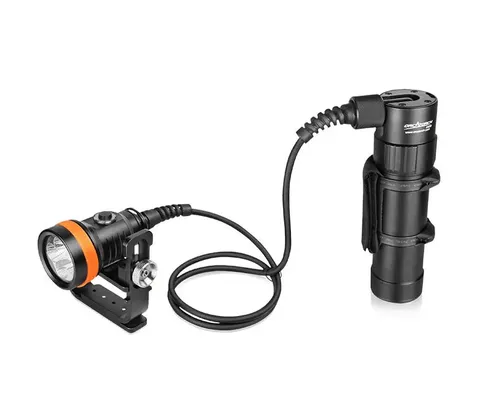
10. D630 V2.0 4600 Lumens Canister Light

OrcaTorch

$500–$650

A true canister light with a 4+ hour high burn time and a tight 7° super-focus beam, built for cave and wreck penetration, and the entry point if you're moving toward technical diving.

Best for: Divers transitioning to tech/overhead diving who want a real canister light

Long 4 hr 20 min burn at full 4600 lm output · Canister battery pack doubles as a power bank · Tight 7° beam ideal for overhead and signaling · Auto emergency-light mode when the pack drops below 10%

Canister-and-cord setup is more than recreational divers need · Heavy and a commitment to rig and travel with · High price for open-water use

How we choose

Picks were assembled from hands-on dive-press testing (ScubaLab, Bluewater Photo, DIVEIN, Backscatter), long-running enthusiast threads on ScubaBoard and BudgetLightForum, and manufacturer specs cross-checked against multiple retailers for current US street pricing. We weighted real-world recreational usefulness over headline lumen counts: beam quality and burn time, switch reliability and glove-friendliness, battery practicality (standard cells and USB-C charging score higher than proprietary bricks), depth rating, and brand track record for surviving salt water. Ranking is by overall recommendation for a typical recreational diver, not by price. Which is why a proven mid-priced torch outranks the brightest canister on the list. Tiers reflect role and price: budget ($40–$90) covers backups and capable first primaries; mid ($110–$270) covers the do-everything primaries most divers should buy; premium ($500+) covers high-output video, tech, and canister lights that exceed open-water needs. This is an independent editorial guide. No manufacturer paid for placement or review, and retail links may be affiliate links that do not affect rank or pricing.

Common questions

More than you'd think for daytime, less than the marketing implies for everything else. For daytime reef diving where you just want to restore color and peek into cracks, 500–1,000 lumens is plenty. For night dives, dusk dives, or murky/low-viz water, 1,000–3,000 lumens is the sweet spot. Beyond about 3,000 lumens you're into video-light and tech-light territory, impressive, but the extra output mostly backscatters off particles in open water rather than helping you see.

A primary is your main, brighter, longer-burning light. A backup is smaller, simpler, and lives in a BC pocket as redundancy in case the primary floods or dies, losing your only light on a night dive is a genuine safety problem. Any diver who does night or overhead diving should carry two lights. A nice trick: a capable 1,000-lumen budget torch (like the OrcaTorch D520 or D550) makes an excellent backup now and can serve as your primary while you learn what you want.

A narrow beam (roughly 8–15°) punches through murky water, signals your buddy clearly, and is preferred by many night divers and for pointing out critters. A wide beam (60–120°) lights up a broad scene and is what you want for video, photography, or general 'see everything in front of me' diving. If you can't decide, several lights here (Tovatec Fusion 1000, Mares EOS 20LRZ) have an adjustable head that slides between the two underwater, and some premium lights output both beams at once.

Plan for your light to outlast your longest planned dive plus a margin. Most quality lights run 1.5–4 hours on full power and much longer on lower settings. A typical recreational dive is under an hour, so almost any light here covers a single dive, but burn time matters if you do multiple dives between charges or run on high the whole time. Always check the rating at full output, not the inflated 'low mode' number.

For most recreational divers, yes. Lights that run on common cells (18650, 21700, 26650) with USB-C charging are cheaper to feed, easy to carry spares for, and simple to replace when a cell ages. Proprietary canister packs deliver longer burn times and higher output but cost more, can't be swapped mid-trip without a backup pack, and tie you to one manufacturer. Standard-cell lights dominate the budget and mid tiers here for exactly this reason.

The two killers are flooding and corrosion. Rinse the light in fresh water after every saltwater dive, and never open it while wet or salty. Inspect and lightly grease the O-rings on a schedule, keep the sealing surfaces free of hair and grit, and store it with the battery partially charged and the switch in 'travel'/lockout mode if it has one. Don't turn a high-output light on in air for more than a few seconds, many rely on water for cooling and will overheat.

Some links are affiliate links, and we may earn a commission at no extra cost to you. It never affects our rankings.

In your pocket

Take every dive site with you.

Free, no account needed. Dive-site charts, coastal webcams, and your dive log in your pocket.

  • Every dive shop and charter in your pocket

  • Reefs, wrecks, and walls charted on the map

  • File a dive plan before a remote shore entry

  • Coastal and harbor cams before you make the drive

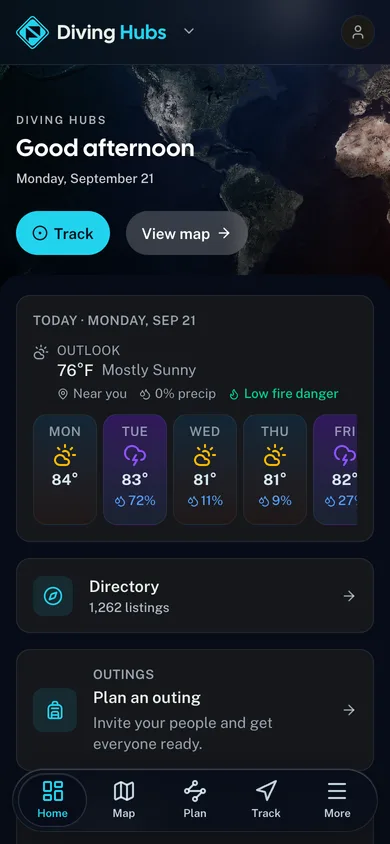
The Diving Hubs app dashboard

For operators

Run your dive business?
Launch your branded surface.

Get your own branded surface in the Diving Hubs app and a directory listing in minutes. Bookings, digital waivers, and your whole operation live in one cockpit.